
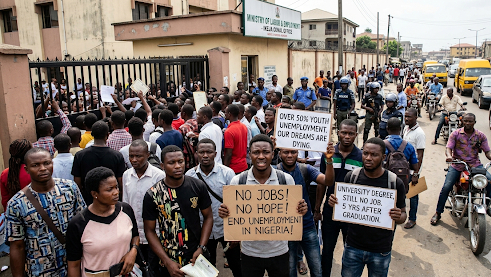

Unemployment remains one of the most pressing socio-economic challenges in Nigeria. Despite various government programs, interventions, and private sector efforts, the number of jobless citizens—especially among young people—continues to rise. This growing trend has far-reaching consequences for economic stability, security, and national development.
So why does unemployment keep increasing in Nigeria?
1. Rapid Population Growth Outpacing Job Creation
Nigeria’s population is growing at a very fast rate, with millions of young people entering the labor market every year. Unfortunately, job creation has not kept pace.
Each year:
- Universities and polytechnics produce new graduates
- Thousands of secondary school leavers seek employment
- The labor market becomes increasingly saturated
When job creation lags behind population growth, unemployment becomes inevitable.
2. Weak Industrial and Manufacturing Base
A strong manufacturing sector is essential for large-scale job creation. However, Nigeria’s industrial base remains underdeveloped.
Many factories struggle with:
- Unstable electricity supply
- High cost of production
- Import dependency for raw materials
As a result, industries that should be major employers are either shrinking or operating below capacity.
3. Overdependence on the Public Sector
For many Nigerians, government jobs are seen as the most desirable form of employment due to stability and benefits. However, the public sector cannot absorb the growing number of job seekers.
This overreliance creates:
- Excess pressure on limited government vacancies
- Long waiting periods for recruitment
- Frustration among qualified candidates
The private sector, which should fill the gap, is not expanding fast enough.
4. Skills Mismatch in the Labour Market
One of the major structural issues is the gap between what schools teach and what industries need. Many graduates leave school without practical, job-ready skills.
Common issues include:
- Theoretical rather than practical education
- Limited technical and vocational training
- Weak link between academia and industry
As a result, employers often struggle to find candidates with the right skills, even while unemployment remains high.
5. Economic Instability and Business Closure
Macroeconomic challenges such as inflation, currency instability, and rising operating costs have forced many businesses to downsize or shut down entirely.
When businesses close:
- Jobs are lost
- Hiring freezes occur
- Investor confidence declines
This creates a cycle where unemployment feeds further unemployment.
6. Insecurity and Regional Disruptions
Insecurity in parts of the country has also contributed significantly to unemployment. In affected regions, businesses are disrupted, farms are abandoned, and economic activities slow down.
This leads to:
- Loss of livelihoods
- Displacement of workers
- Reduced investment in vulnerable areas
Without stability, job creation becomes difficult.
7. Weak Support for Small and Medium Enterprises (SMEs)
SMEs are one of the largest sources of employment globally. In Nigeria, however, many small businesses struggle to survive due to:
- Limited access to affordable credit
- High taxation and regulatory burdens
- Poor infrastructure
When SMEs fail to grow, the economy loses its biggest job-creation engine.
8. Corruption and Inefficient Resource Allocation
Corruption and mismanagement of public resources also play a role in limiting job creation. Funds that could be invested in infrastructure, education, and industrial development are sometimes diverted or poorly utilized.
This leads to:
- Delayed development projects
- Weak economic growth
- Reduced employment opportunities
The Consequences of Rising Unemployment
The effects of unemployment extend beyond economics. It contributes to:
- Increased poverty levels
- Social unrest and crime
- Youth frustration and migration (“Japa syndrome”)
- Reduced national productivity
A society with high unemployment struggles to achieve sustainable development.
What Can Be Done?
Addressing unemployment requires coordinated efforts across multiple sectors:
- Economic diversification into agriculture, technology, and manufacturing
- Investment in vocational and technical education
- Support for SMEs through financing and policy reforms
- Improved infrastructure, especially electricity and transport
- Stronger security to attract investment
Conclusion: A National Challenge That Requires Urgent Action
Rising unemployment in Nigeria is not caused by a single factor—it is the result of interconnected economic, structural, and policy challenges.
Solving it will require more than short-term programs. It demands long-term planning, consistent implementation, and a commitment to building an economy that creates opportunities for all.
For millions of Nigerians searching for work, the urgency cannot be overstated. The time to act is now.
NationEchoes continues to spotlight the critical issues shaping Nigeria’s economy, governance, and future.